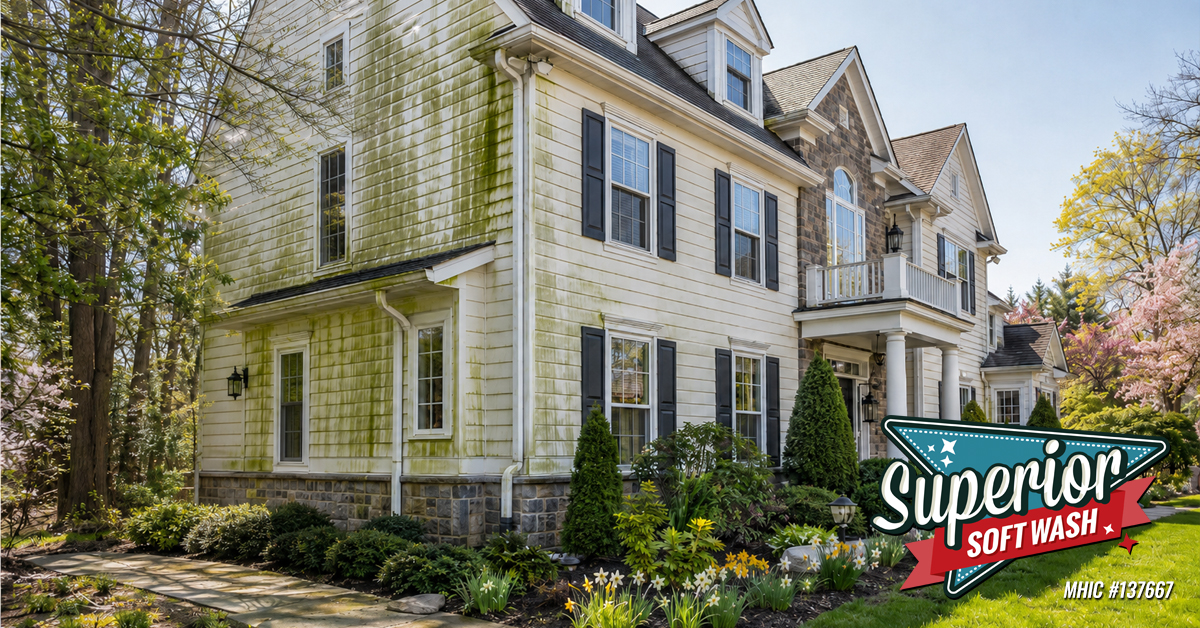
“Why Does My House Turn Green every spring?” is a question many Maryland homeowners ask. One week, your siding looks fine. Then suddenly, green streaks appear near the shaded side. Before long, your trim, shutters, gutters, and walkways look older than they should.
That green buildup is frustrating because it returns so quickly. You may scrub one area, only to see another section turn green. However, the problem is not simply dirt. It’s organic growth living on your exterior surfaces.
Soft washing does more than make your home look clean. It kills the organic growth causing the stains. Better yet, it protects delicate surfaces, uses less water, and lasts longer than power washing.
Why Siding Turns Green in Spring
Spring brings warmer weather, longer days, and plenty of moisture. Unfortunately, those conditions also promote the growth of algae and mildew. Rain wets the siding, while humidity keeps it damp longer. Then pollen and dirt stick to the wet surface.
Trees can make the problem worse. Branches create shade and block sunlight that would otherwise dry the siding. Leaves also drop pollen, sap, and organic debris onto nearby surfaces. As a result, the side near the trees often turns green first.
Maryland weather adds another challenge. Spring rains can be frequent, and mornings often stay damp. Because of that, siding becomes the perfect place for growth.
Shade, Trees, Humidity, and Rain
Algae and mildew love moisture. They also grow faster when sunlight cannot dry the surface. That is why shaded walls often show stains before sunny walls do.
Trees create shade, but they also retain moisture near the house. Meanwhile, rain splashes dirt and organic matter onto the lower siding. Over time, those particles feed the growth.
Humidity keeps everything damp even after the rain stops. Consequently, green stains spread across vinyl siding, trim, soffits, and gutters. Once growth takes hold, it rarely disappears on its own.
Why the North Side Often Looks Worse
Many homeowners notice the north side looks greener than the rest. This happens because the north side receives less direct sunlight. Without strong sun, siding stays damp longer after rain or dew.
Cooler temperatures also slow evaporation. So, moisture lingers on siding, shutters, and trim. Eventually, algae and mildew settle in and spread.
This is another reason people ask, “Why Does My House Turn Green?” The answer often starts with shade, moisture, and limited sunlight. When those factors combine, green growth becomes very common.
Green Stains Are Not Just Dirt
It is easy to think green stains are just dirt. However, dirt does not usually spread across siding on its own. Organic growth spreads because it is alive.
Mildew, algae, bacteria, fungus, moss, and lichens can all discolor surfaces. They cling to siding and feed on moisture and organic debris. Additionally, they can spread into small seams and textured areas.
Power washing may make the surface look better for a short time. Still, it often removes only the visible layer. If the growth remains at the root, the stains return quickly.
How Mildew and Algae Spread Across Vinyl Siding
Vinyl siding is durable, but it still collects moisture and debris. Small ridges and seams can trap pollen, dust, and spores. Then algae and mildew use those areas as starting points.
Wind can move spores from one side to another. Rain can also carry growth down the wall. Soon, one small green patch becomes a larger stained area.
The spread is often gradual, so homeowners may not notice immediately. Then spring arrives, and the growth becomes more obvious. At that point, a proper house soft wash can make a dramatic difference.
Why Power Washing Is Not the Best Answer
Power washing depends on force. That force can remove surface grime, but it can also cause damage. High pressure may force water behind vinyl siding and around trim.
Pressure can also damage caulk lines, shutters, painted surfaces, and gutters. On roofs, power washing can strip protective granules from shingles. That damage can shorten the roof’s lifespan and lead to costly repairs.
Even when power washing looks successful, the results may not last. Since it often misses the root growth, stains can return fast. Therefore, high pressure is not always the best solution.
How Superior SoftWash Cleans the Right Way
Superior SoftWash uses Authentic SoftWash techniques, not harsh blasting. Instead of a pressure washer, we use a 12-volt battery operated sprayer system. Our team applies a water-based, biodegradable cleaning solution at about 50 psi.
That pressure is close to garden hose pressure. The solution emulsifies dirt and grime, which helps release buildup safely. It also kills mold, mildew, algae, bacteria, fungus, moss, and lichens.
Our Superior Secret Sauce also breaks down spider webs and bug nests. After the solution works, we rinse everything away at garden hose pressure. The result is a cleaner, sanitized surface without the damage of power washing.
Why Soft Washing Lasts Longer
Soft washing lasts longer because it treats the source. Rather than just removing the top layer, it kills organic growth at the root. That means the green stains do not come back as quickly.
Superior SoftWash results last three to six times longer than power washing. Many clients enjoy a clean that lasts around four years. So, you avoid yearly washing and constant frustration.
This also makes soft washing a smarter investment. You get a cleaner exterior, better surface protection, and fewer repeat cleanings. Plus, our process uses two-thirds as much water as power washing.
Protecting Siding, Trim, Shutters, and Gutters
Your exterior has many delicate parts. Vinyl siding can flex, shutters can loosen, and trim can hold moisture. Gutters can also show streaks and collect buildup near the roofline.
Our low-pressure method protects these surfaces while thoroughly cleaning them. We do not blast water into seams or behind siding. Instead, we let the cleaning solution do the work.
This careful approach helps your exterior look better without unnecessary risk. It also gives your home a more complete refresh. Clean siding looks even better when trim, shutters, and gutters are clean too.
Clean More Than Just the Siding
A green house is often only part of the story. Patios, walkways, decks, and driveways can also collect organic growth. These areas may become stained, slippery, or dull after a damp spring.
Once your siding looks fresh, those surfaces stand out more. That is why many homeowners add patio cleaning, walkway cleaning, deck washing, or driveway cleaning. These services help finish the look and improve outdoor spaces.
Clean walkways also feel safer for family and guests. Meanwhile, clean decks and patios make grilling season more enjoyable.
Ready to Stop the Green From Coming Back?
Suppose you have been asking, “Why Does My House Turn Green?” Now you know the answer. Green stains come from moisture, shade, trees, humidity, and organic growth. Thankfully, Superior SoftWash can remove the growth safely and help it stay gone longer.
Call now for your free estimate on the best care for your home. Ask about house washing, roof washing, gutter cleaning, deck washing, patio cleaning, walkway cleaning, and driveway cleaning. With Superior SoftWash, your exterior can look cleaner, brighter, and ready for the season.

 BBB Rating & Accreditation


